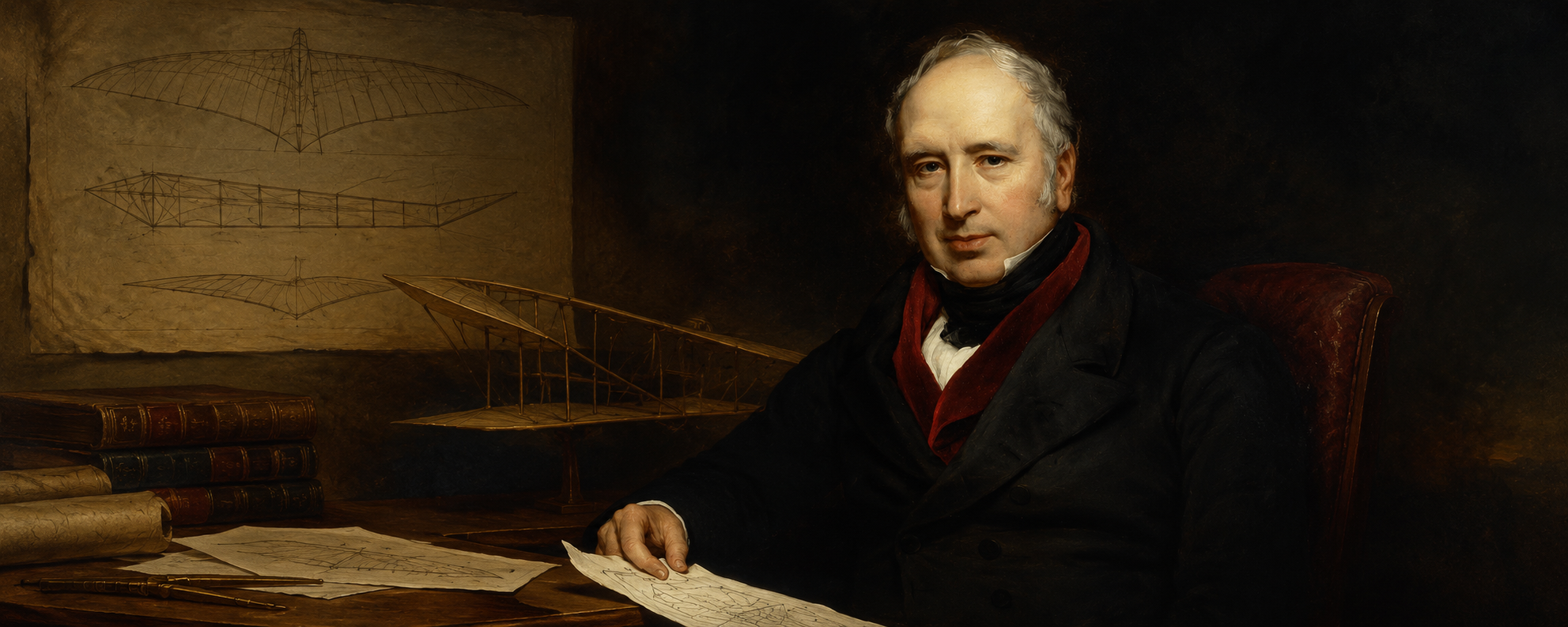

Long before powered aircraft crossed the sky, one English engineer was working out how a heavier-than-air machine could fly. He studied the forces acting on a wing, explored ways to make an aircraft stable, and developed designs that helped establish the principles of modern aviation.
His name was Sir George Cayley.
Born in 1773, Cayley is widely regarded as one of the founding figures of aeronautics. His work helped separate three essential functions of an aircraft: generating lift, providing propulsion, and controlling flight. He explored these ideas through drawings, experiments, model aircraft, and full-sized gliders.
Although Cayley did not live to see powered flight become practical, his research laid important foundations for the aircraft that followed. His experiments also occupy a significant place in gliding history, where understanding how a wing moves through the air is central to flight.
Who Was Sir George Cayley?
Sir George Cayley was an English engineer, inventor, and scientific thinker born on 27 December 1773 in Scarborough, Yorkshire, England. He lived at Brompton Hall, near Scarborough, and spent much of his life investigating problems in mechanics, engineering, and flight.
Cayley approached flying as a scientific problem rather than simply an exercise in imitation. Birds had inspired people to imagine human flight for centuries, but copying their flapping wings was not necessarily the best way to build a practical aircraft. Cayley investigated the forces that made flight possible and considered how a machine could generate lift, remain stable, and move in a controlled direction.
His interests extended far beyond aviation. He worked on inventions and engineering problems involving wheels, agricultural machinery, lifeboats, and other practical technologies. Yet his investigations into flight became his most enduring legacy.
Cayley died on 15 December 1857. His ideas helped establish the scientific framework on which later aviation developed.
The Idea That Changed Aircraft Design
One of Cayley’s most important contributions was recognising that an aircraft did not need to operate like a bird.
In a bird, the wings provide lift and also contribute to propulsion through flapping. Cayley explored a different arrangement: a fixed wing could generate lift while a separate mechanism provided forward motion. A tail could help the aircraft maintain stability and change direction.
This separation of functions was a major step towards the configuration used by modern fixed-wing aircraft.
The idea can be understood through three basic questions:
- Lift: How can the aircraft generate an upward aerodynamic force?
- Propulsion: How can it move forward through the air?
- Control and stability: How can it maintain a useful attitude and respond to changes in direction?
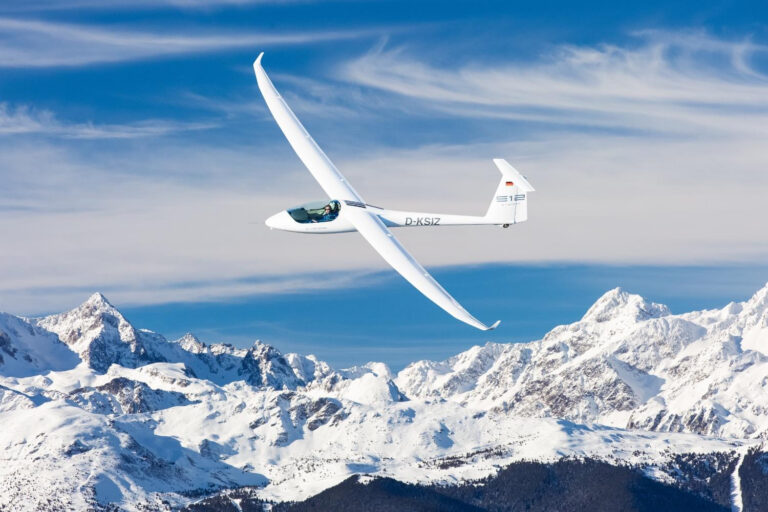
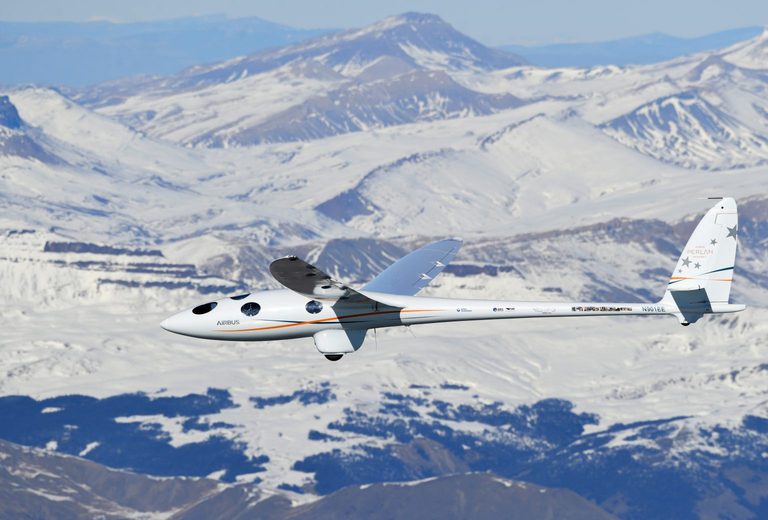
A glider does not require an engine to provide thrust. It moves forward as it descends through the air, converting some of its gravitational potential energy into motion. Its wings generate lift while aerodynamic drag resists its movement.
Cayley’s work helped explain why a successful flying machine needed to account for these different functions rather than relying on one mechanism to do everything.
The Silver Disk of 1799
One of the most remarkable objects associated with Cayley’s work is a small silver disk engraved in 1799. It records an early aircraft concept that brought together several ideas central to modern flight.
One side shows an aircraft design with a fixed wing and separate elements for propulsion and control. The reverse contains a diagram illustrating the forces involved in flight.
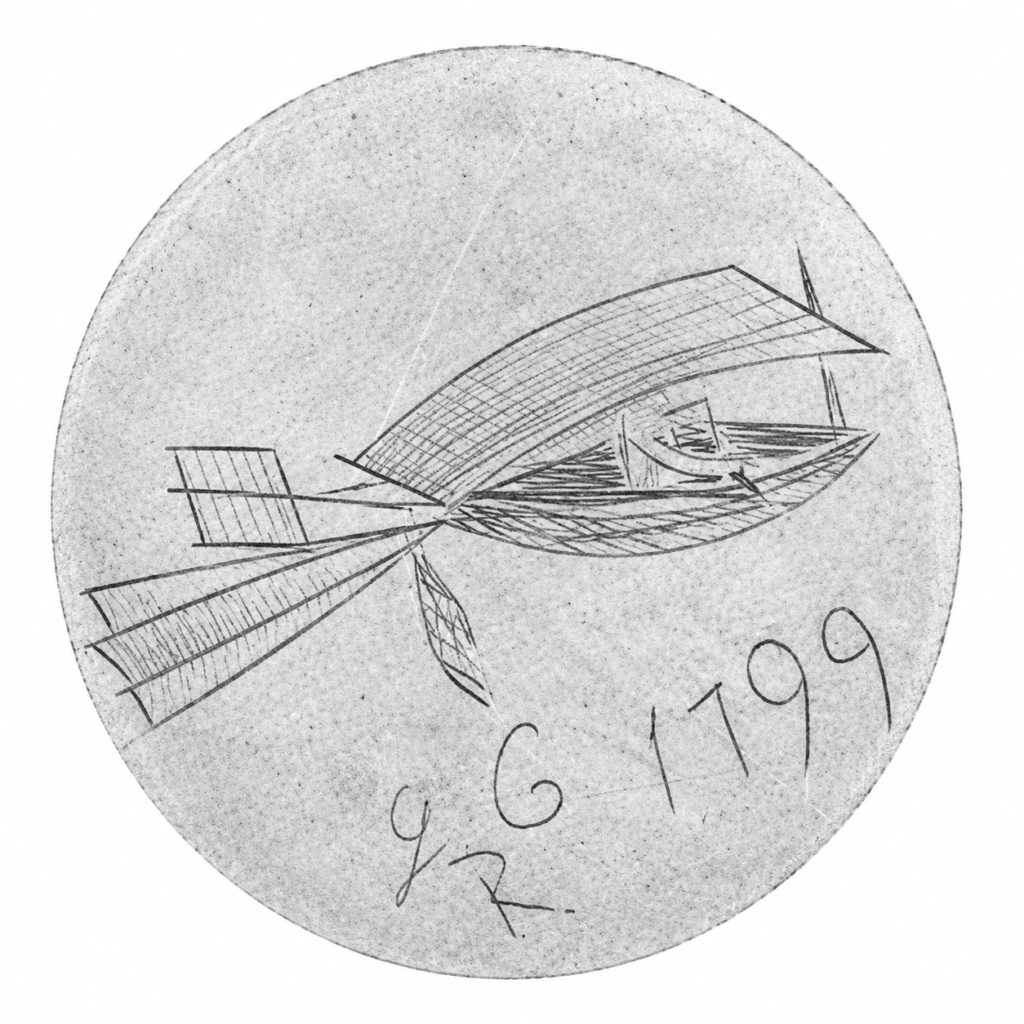
The disk is important because it shows that Cayley was thinking about aircraft as a system of distinct aerodynamic and mechanical functions. Rather than treating flight as a mysterious ability, he was trying to understand the physical principles behind it.
The object is preserved in the collection of the Science Museum in London. You can explore it in the Science Museum Group collection.
The disk was not a finished aircraft. It was a compact record of an idea, one that would guide Cayley’s later experiments and influence the development of fixed-wing flight.
The 1804 Model Glider
By 1804, Cayley had developed and flown a model glider that is widely recognised as an important milestone in the history of fixed-wing aviation.
The model demonstrated that a flying machine could travel through the air using a fixed wing and a separate tail arrangement. Its wing was relatively flat compared with the more developed curved aerofoil shapes associated with later aerodynamic design.
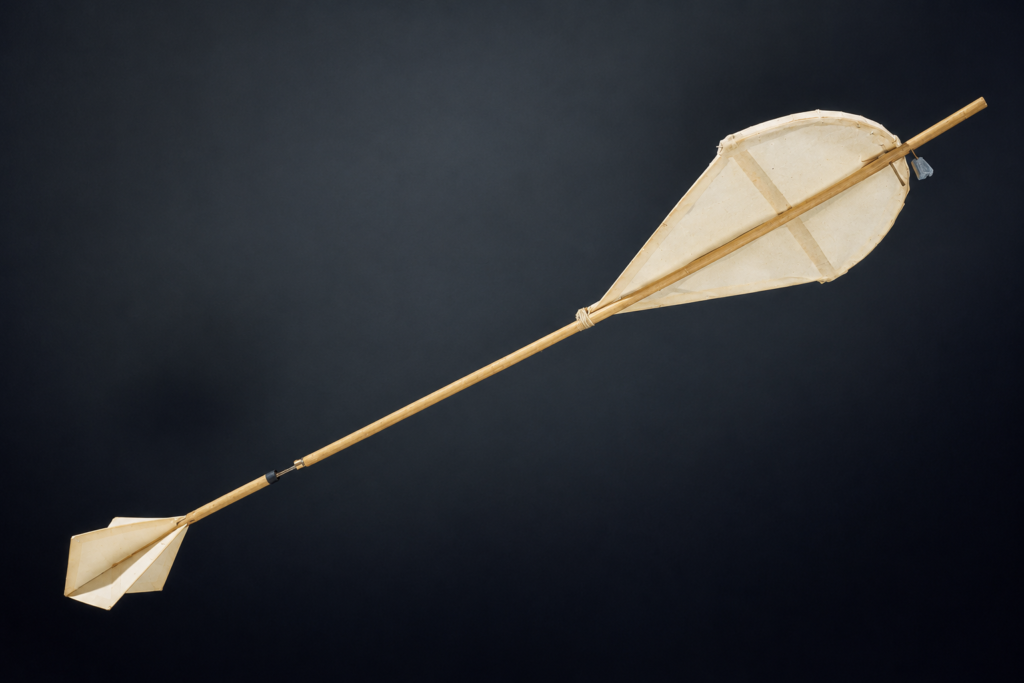
The experiment helped turn Cayley’s theoretical thinking into a practical investigation of flight. It was not a modern glider in miniature, but it tested a coherent aircraft design based on aerodynamic principles.
John Ackroyd’s research paper, Cayley’s 1804 Glider, examines the model’s performance and its place in the history of early fixed-wing flight. Published in the Journal of Aeronautical History in 2019, the paper is available through the Royal Aeronautical Society.
The 1804 experiment was an important step from theory towards practical gliding. It also gave Cayley a foundation for investigating larger flying machines.
Why Wing Shape Matters
Cayley’s work developed over time. His early experiments helped him investigate the basic arrangement of a flying machine, while later studies explored how the shape of a wing influenced its performance.
A wing’s cross-sectional shape affects how air flows around it and the aerodynamic forces it can generate. A curved wing section, often called a cambered aerofoil, can produce useful lift under suitable conditions.
Cayley recognised the value of curved surfaces and included this understanding in his later thinking about aircraft. His work contributed to the gradual development of a more scientific approach to wing design.
This was a significant advance because a wing is not simply a flat surface that holds an aircraft up. Its shape, angle to the airflow, speed through the air, and surrounding conditions all influence the lift and drag it produces.
For glider pilots today, these principles remain fundamental. The aircraft must generate enough lift to support its weight while managing drag and maintaining a suitable flight path.
Understanding the Forces of Flight
Cayley’s investigations helped establish a clearer understanding of the forces involved in heavier-than-air flight. Modern introductory aerodynamics commonly describes four forces: lift, weight, drag, and thrust.
| Force | What it means |
|---|---|
| Lift | The aerodynamic force generated by the wing, acting broadly perpendicular to the airflow |
| Weight | The force of gravity acting on the aircraft |
| Drag | The aerodynamic resistance opposing the aircraft’s motion through the air |
| Thrust | A forward force normally provided by an engine or another propulsion system |
These four forces are a useful way to introduce powered aircraft, but a glider behaves differently because it has no engine producing thrust.
During a steady glide, the aircraft descends along a flight path. A component of its weight acts along that path and helps balance aerodynamic drag. Meanwhile, the wing generates lift to support the aircraft against the component of weight acting perpendicular to the flight path.
In simple terms, a glider trades altitude for forward motion. It does not need an engine to keep moving, but it must manage its energy carefully. If it encounters rising air, such as a thermal or a mountain wave, it may gain altitude relative to the ground despite having no engine.
Cayley’s work helped move the study of flight towards this kind of scientific explanation. His ideas were an important part of the foundation on which later aerodynamic research developed.
From Models to Full-Sized Gliders
A model can demonstrate an idea, but a full-sized aircraft introduces new challenges. Its structure must carry greater loads, its controls must work reliably, and its aerodynamic behaviour must remain manageable with a person aboard.
Cayley continued to explore how his principles could be applied to larger machines. His experiments eventually led to accounts of gliders capable of carrying a person, although the historical evidence for individual flights is not equally complete.
Two dates are particularly important in discussions of his work: 1849 and 1853. They are associated with different stages of his experimentation and should not be treated as equally well-documented events.
The 1849 Glider Experiment
Historical accounts describe a glider experiment by Cayley in 1849 in which a boy was reportedly carried a short distance down a slope.
The surviving details are limited and accounts differ, so this experiment is less firmly documented than much of Cayley’s other work. It is sometimes described as the first manned heavier-than-air flight, but the larger glider associated with 1853 is the more widely recognised milestone.
Although the evidence is incomplete, the story reflects the direction of Cayley’s work: moving beyond small models and exploring whether a person could be carried by a heavier-than-air flying machine.
The Governable Parachute Design
In 1852, a design associated with Cayley and known as the Governable Parachute appeared in Mechanics’ Magazine. Despite its name, the design was not simply a conventional parachute. It was an unpowered flying machine intended to carry a person and be guided through the air.
The design used a large kite-like lifting surface supported by a frame, with a body or carriage suspended beneath it. It also included tail surfaces intended to provide stability and control.
The design reflected Cayley’s continued interest in combining lift, stability, and steering in a single flying machine. Its structure was very different from that of a modern glider, but the underlying challenge was familiar: create enough lift to support the aircraft and pilot, then provide a way to guide the machine safely.
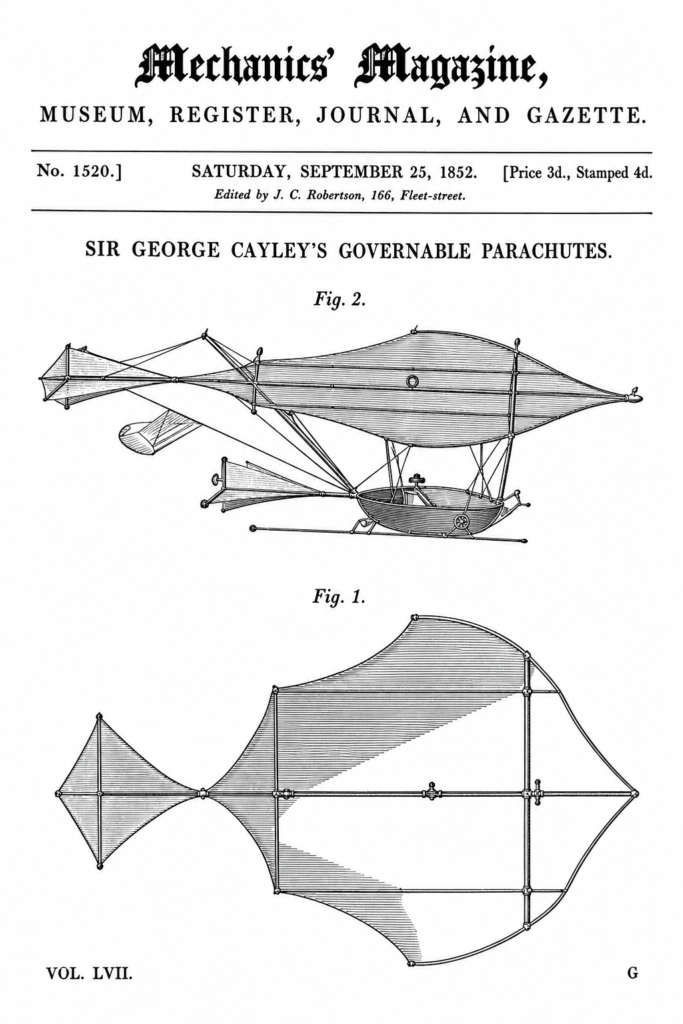
The glider flown in 1853 is generally associated with the Governable Parachute design. However, no surviving drawing conclusively establishes every detail of the aircraft used in that flight.
A copy of the relevant Mechanics’ Magazine material is available as a PDF hosted on a third-party website. This is a secondary hosting location rather than the publisher’s own archive.
The 1853 Flight
Cayley’s most famous gliding experiment is commonly dated to 1853, though the account rests substantially on later recollections.
Historical accounts describe a full-sized glider carrying a person across or down Brompton Dale, near Cayley’s home in Yorkshire. The person aboard is traditionally identified as Cayley’s coachman. According to the familiar story, the man was reportedly unhappy about being asked to fly when he had been employed to drive. The anecdote has become part of the popular history of early aviation, although it should be understood as a story passed down through later accounts rather than a fully documented flight record.
Even with these limitations, the reported flight is widely recognised as a milestone in the development of heavier-than-air flight. It represents an early attempt to carry a person in an unpowered flying machine designed around aerodynamic principles.
The 1853 event should not be confused with the first powered flight. Cayley’s aircraft had no engine. Its motion depended on gravity and the conditions of its launch and descent.
What Happened to Cayley’s Glider Design?
Cayley’s work, produced decades before powered flight became practical, helped establish principles that later aviation pioneers could develop further.
His approach to fixed wings, separate propulsion, and aircraft control became part of the broader scientific understanding of flight. Later designers improved wing shapes, structures, control systems, and propulsion, but the questions Cayley investigated remained central.
Gliding also continued to provide a way to explore flight without requiring an engine. By studying how a glider moved through the air, engineers and pilots could learn about lift, drag, stability, and control.
Cayley’s legacy is therefore not limited to one particular aircraft. It lies in his method of studying flight and in the principles he helped bring together.
Derek Piggott and the Cayley Glider Replica
Cayley’s experiments have also been revisited through modern reconstructions.
Sources differ on exactly when the replica was completed, giving 1973 or 1974. The Aviation Gazetteer dates both construction and flight to 1973, while the Yorkshire Air Museum gives 1974 as the build year and confirms that Derek Piggott flew it at Brompton Dale, towed behind a car.
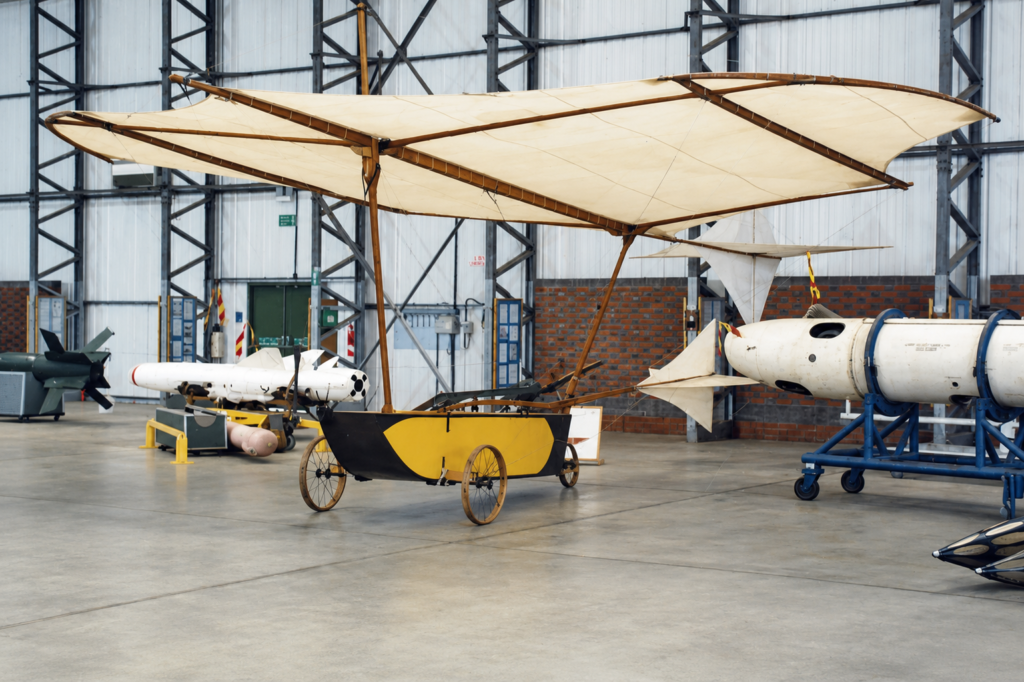
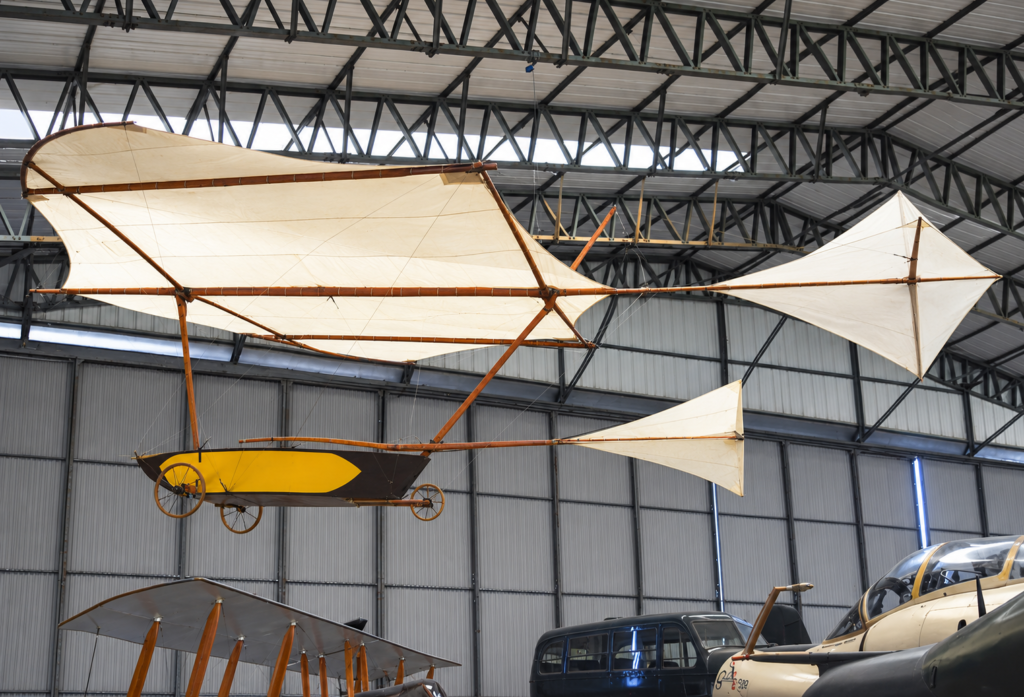
The replica was built by Ken Fripp at Southdown Aero Services, based on the published Governable Parachute design. It used a large linen lifting surface stretched over a wooden keel and spars, with a suspended body and tail surfaces for stability and steering. The replica was later flown again for the IMAX film On the Wing.
The replica was displayed at the Museum of Science and Industry in Manchester until 1998, when it was moved to the Yorkshire Air Museum at Elvington. The museum says the aircraft resides in its main display hangar, with occasional appearances outside in very calm conditions. Visitors should check the museum’s official website for current visitor information.
You can read more about the aircraft and its reconstruction through the Yorkshire Air Museum’s Cayley Glider page and the Aviation Gazetteer’s detailed replica profile.
Piggott’s flight did not recreate every detail of Cayley’s original experiment, but it demonstrated how a reconstruction based on an early design could be tested and flown. It also helped bring Cayley’s work to a modern audience.
Beyond Aviation: Cayley the Inventor
Although Cayley is best known for his work on flight, his interests extended into many areas of engineering.
His inventions and investigations included a tension-spoke wheel, a forerunner of the tension-spoked wheel used in later bicycle designs, and a tracked vehicle concept associated with the development of the caterpillar tractor. He also worked on lifeboat design and other practical engineering challenges.
Cayley’s broad interests mattered because he approached problems by looking for the physical principles behind them. Whether he was considering a wheel, a vehicle, or a flying machine, he tried to understand how a design could perform its intended function more effectively.
His aviation work was part of this wider habit of experimentation and scientific thinking.
Why Is He Called Sir George Cayley?
Cayley was a baronet, a hereditary title in the British honours system. He was the sixth Baronet of Brompton Hall, which is why he is commonly referred to as Sir George Cayley.
The title is separate from his reputation as a pioneer of aviation. His importance in the history of flight comes from his experiments, designs, and scientific ideas rather than from his hereditary title.
A Brief Timeline of Sir George Cayley
| Year | Milestone |
|---|---|
| 1773 | George Cayley was born in Scarborough, Yorkshire, England. |
| 1799 | He recorded an early fixed-wing aircraft concept on a silver disk. |
| 1804 | He developed and flew an influential model glider. |
| 1809–1810 | He published On Aerial Navigation in three parts, explaining important principles of flight and aircraft design. |
| 1849 | A glider experiment reportedly carried a boy, although the surviving historical details are limited. |
| 1852 | The Governable Parachute design was published in Mechanics’ Magazine. |
| 1853 | A full-sized, person-carrying glider flight is commonly dated to this year. |
| 1857 | Cayley died, leaving behind important foundations for later aviation. |
| 1973 | Derek Piggott flew a replica of the Governable Parachute at Brompton Dale for a television programme; some sources date the replica’s completion to 1974. |
Frequently Asked Questions
Sources and Further Reading
- Science Museum Group: George Cayley
- Science Museum Group: Cayley’s 1799 silver disk
- Royal Aeronautical Society: Cayley’s 1804 Glider, by John Ackroyd
- NASA: On Aerial Navigation, Cayley’s 1809–1810 papers
- Yorkshire Air Museum: Cayley Glider
- Aviation Gazetteer: Cayley Governable Parachute replica
- Mechanics’ Magazine material on Cayley’s Governable Parachute, hosted by a third-party website
- International Civil Aviation Organization: Scientific visionaries before the Wright brothers
Conclusion
Sir George Cayley helped transform human flight from an ambitious idea into a subject that could be investigated scientifically. His work on fixed wings, aerodynamic forces, stability, and control shaped the foundations of modern aviation.
His early model glider in 1804 and the person-carrying glider flight commonly dated to 1853 mark important stages in that journey. Although some details of the earliest full-sized experiments remain uncertain, Cayley’s broader contribution is clear: he helped explain how a heavier-than-air machine could fly.
For modern glider pilots, that legacy is still relevant. Every unpowered flight depends on the relationship between lift, drag, weight, and the movement of air. Cayley was among the pioneers who helped make those relationships understandable.