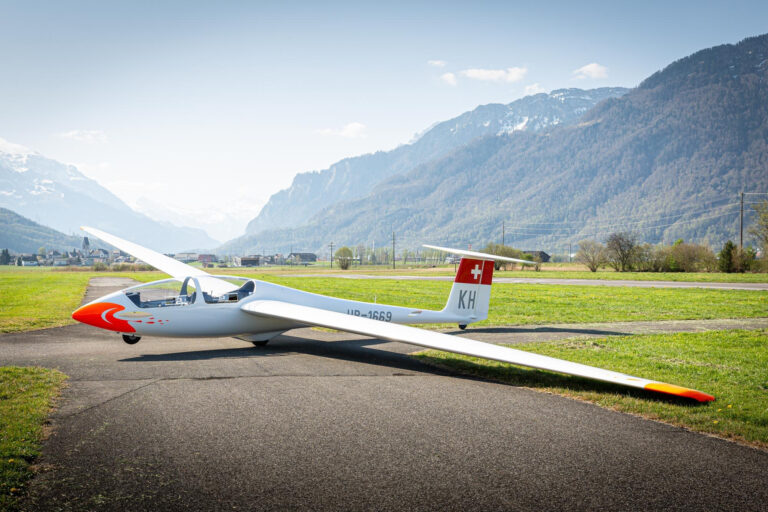
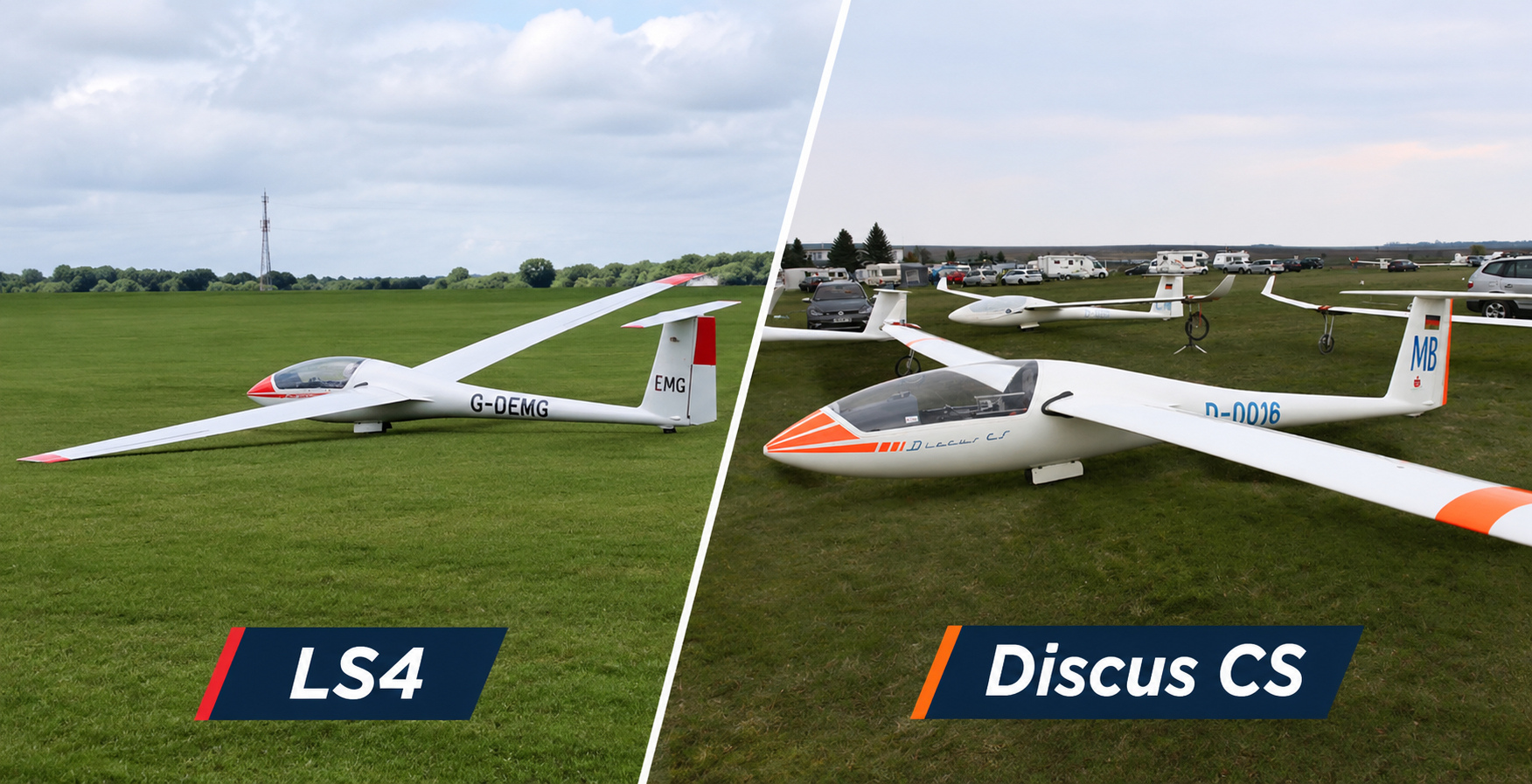

Two 15-meter gliders, two established designs, and a question that cannot be answered by glide ratio alone. The Rolladen-Schneider LS4 and Schempp-Hirth Discus CS are both respected Standard Class gliders, but their differences become more interesting when we look beyond the specifications.
Both aircraft were developed for efficient soaring, with retractable landing gear, water ballast systems, and the ability to undertake serious cross-country flights. Yet their wing designs, handling characteristics, and operational considerations give pilots different reasons to choose one over the other.
The LS4 is particularly well known for its forgiving handling and thermalling characteristics. The Discus CS combines a distinctive wing design with strong published glide performance and established cross-country capability.
But which glider performs better in weak lift? How significant is the difference in glide ratio? What happens when water ballast is added? And which aircraft makes more sense for a pilot considering private ownership?
This detailed comparison examines their design, aerodynamic performance, thermalling, cross-country flying, handling, cockpit comfort, maintenance, and ownership considerations.
LS4 vs Discus CS: Specifications Compared
| Specification | LS4 | Discus CS |
|---|---|---|
| Manufacturer | Rolladen-Schneider | Schempp-Hirth design, Czech production |
| Aircraft class | Standard Class | Standard Class |
| Seats | 1 | 1 |
| Wingspan | 15 m | 15 m |
| Wing area | 10.5 m² | 10.58 m² |
| Aspect ratio | Approx. 21.4 | Approx. 21.3 |
| Published best glide ratio | Approx. 40.5:1 | 42.2:1 |
| Published minimum sink | Approx. 0.60 m/s | 0.61 m/s |
| Wing flaps | No | No |
| Landing gear | Retractable | Retractable |
| Water ballast | Yes | Yes |
| Tail configuration | T-tail | T-tail |
Note: Performance figures are published reference values, not results from a controlled head-to-head test. The Discus CS figures refer to the conditions specified in its flight manual. LS4 variants and individual aircraft configurations may differ.
1. Origins and Development
Rolladen-Schneider LS4
The LS4 was introduced in the early 1980s by Rolladen-Schneider, a German manufacturer with an established history of producing competition gliders.
It was developed as a 15-meter Standard Class glider, combining competitive performance with handling characteristics suitable for a broader range of pilots.

The aircraft features a T-tail, retractable landing gear, and a wing without camber-changing flaps. Its design reflects a balance between aerodynamic efficiency, predictable handling, and practical operation.
Over time, the LS4 became popular among gliding clubs and private owners. Its reputation for effective thermalling and manageable handling made it particularly attractive to pilots transitioning from training aircraft into higher-performance single-seat gliders.
The design subsequently evolved into the LS4-a and LS4-b. These versions introduced changes to equipment, structural details, and operating characteristics. Consequently, technical specifications should always be checked against the exact aircraft variant.
Schempp-Hirth Discus CS
The Discus family was developed by Schempp-Hirth during the 1980s as a high-performance Standard Class design.
The Discus CS is a Czech-produced version of the Discus, with its own documentation and production characteristics.
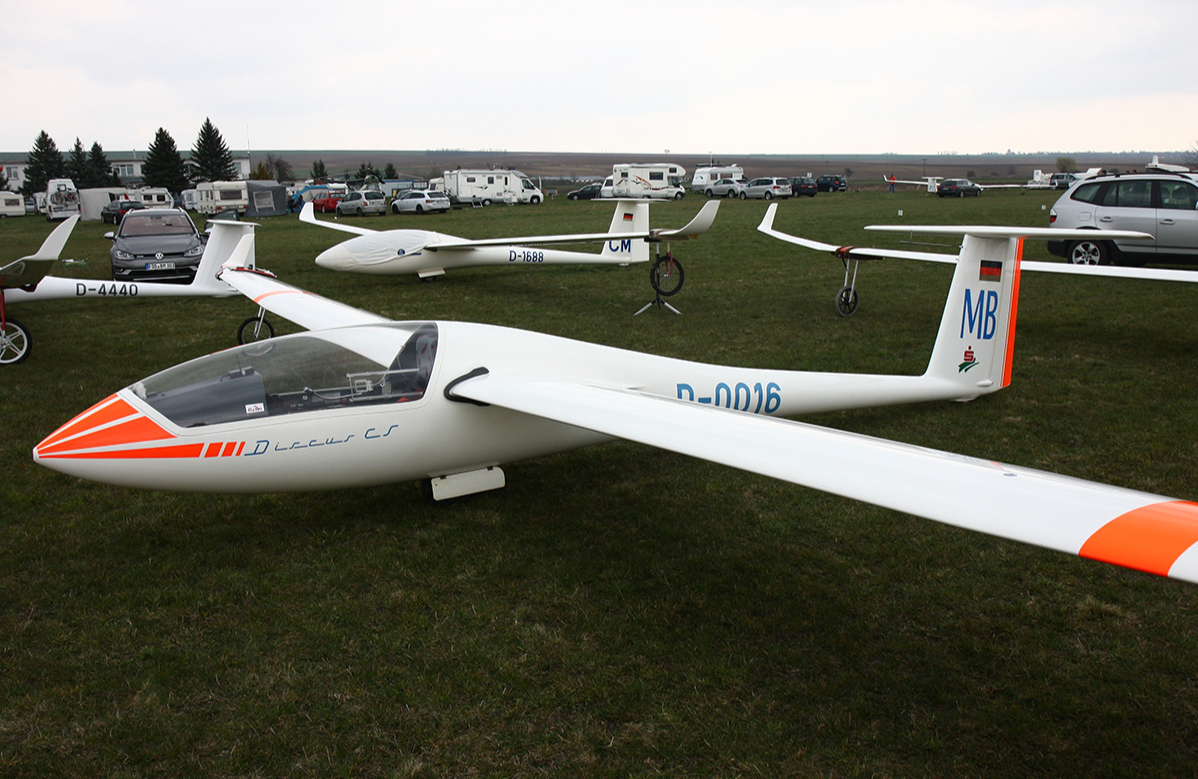
One of its most recognizable features is its distinctive multi-panel wing planform. The swept-back leading edge gives the Discus a noticeably different appearance from more conventionally tapered gliders.
This wing design was developed with aerodynamic efficiency in mind, particularly the relationship between lift distribution and drag.
The Discus CS uses composite construction incorporating glass and carbon fiber reinforced materials. Its structure, retractable landing gear, airbrakes, and ballast systems support its role as a high-performance cross-country aircraft.
Although both gliders belong to the same class, their different design approaches provide an interesting foundation for comparing performance and handling.
2. Wing Design and Aerodynamics
The LS4 and Discus CS share the same 15-meter wingspan, but their wing geometry is not identical.
The LS4 uses a relatively conventional tapered wing design. The Discus CS features a distinctive multi-panel wing with a swept-back leading edge.
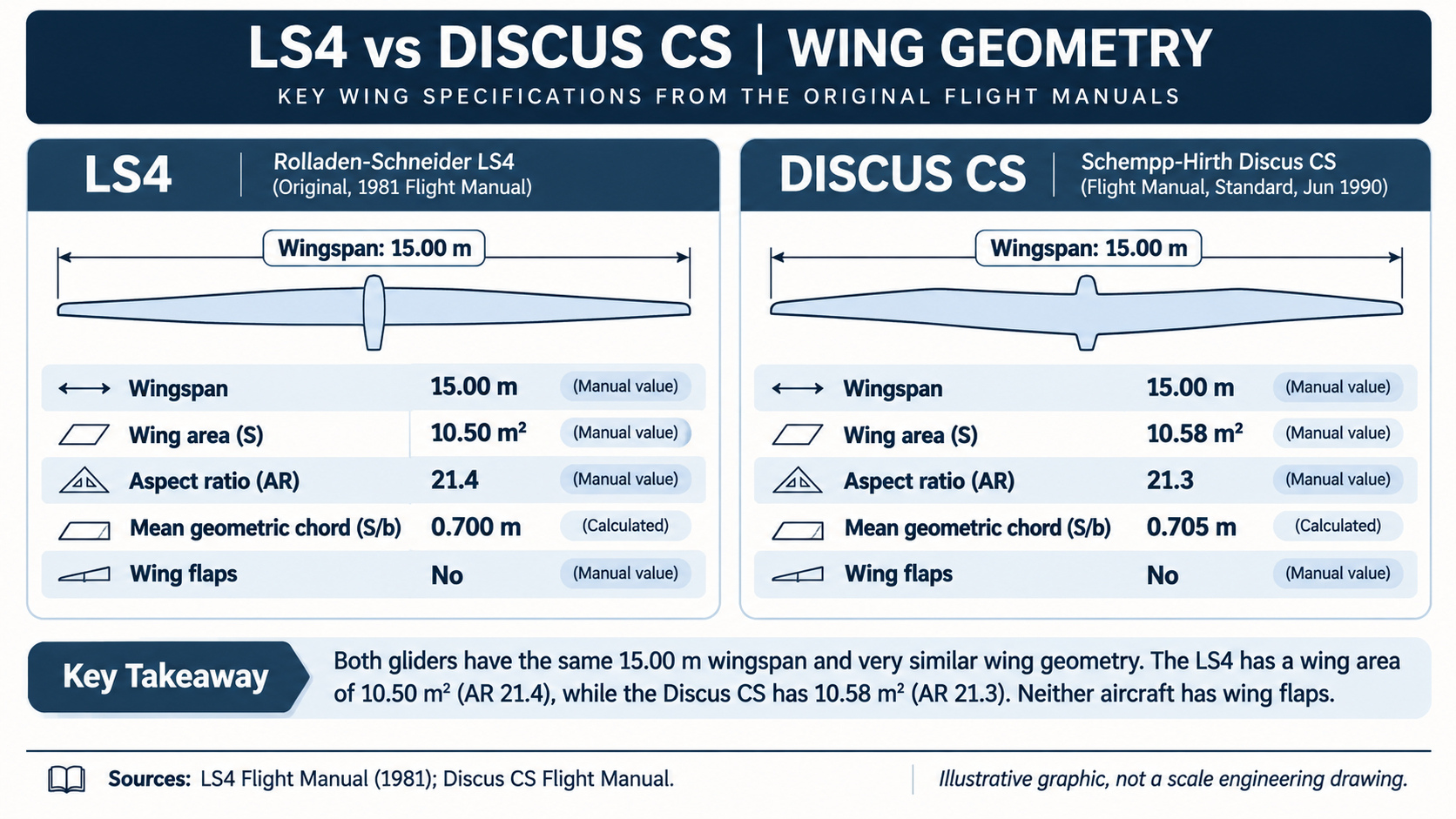
These differences matter because wing geometry affects how lift is distributed across the span and how aerodynamic drag is generated.
Wing Planform and Induced Drag
Induced drag is a consequence of producing lift. It becomes particularly important at lower speeds, when a wing must operate at a higher lift coefficient to support the aircraft.
Wing planform influences the distribution of lift and the resulting induced drag. However, planform alone does not determine overall efficiency.
Airfoil characteristics, wing surface condition, interference drag, and the aircraft’s operating speed also influence performance.
The Discus wing should therefore not be considered automatically superior simply because its shape appears more sophisticated. Its published performance reflects the complete aircraft rather than wing geometry alone.
Aspect Ratio
Aspect ratio describes the relationship between wingspan and wing area.
It is calculated as:
Aspect Ratio = Wingspan² ÷ Wing Area
With a wingspan of 15 meters and a wing area of approximately 10.5 square meters, the LS4 has an aspect ratio of about 21.4.
The Discus CS, with a wing area of approximately 10.58 square meters, has an aspect ratio of about 21.3.
These values are extremely close.
This tells us that the difference in their published glide performance cannot be explained simply by one aircraft having a significantly longer or narrower wing.
Wing Loading
Wing loading describes the aircraft’s mass relative to its wing area.
Wing Loading = Aircraft Mass ÷ Wing Area
Higher wing loading generally increases the airspeed required to produce a given lift coefficient.
It also affects stall speed, minimum sink speed, and the airspeed at which the aircraft achieves its best glide performance.
For glider pilots, wing loading becomes particularly important when deciding whether to carry water ballast.
3. Glide Ratio: Which Glider Travels Farther?
Glide ratio is one of the most widely discussed performance measurements in soaring.
It describes the horizontal distance a glider can travel for a given loss of altitude in still air.
For example, a glide ratio of 40:1 means that an aircraft can theoretically travel 40 kilometers while losing 1 kilometer of altitude, provided it is flown at the appropriate speed under the specified conditions.
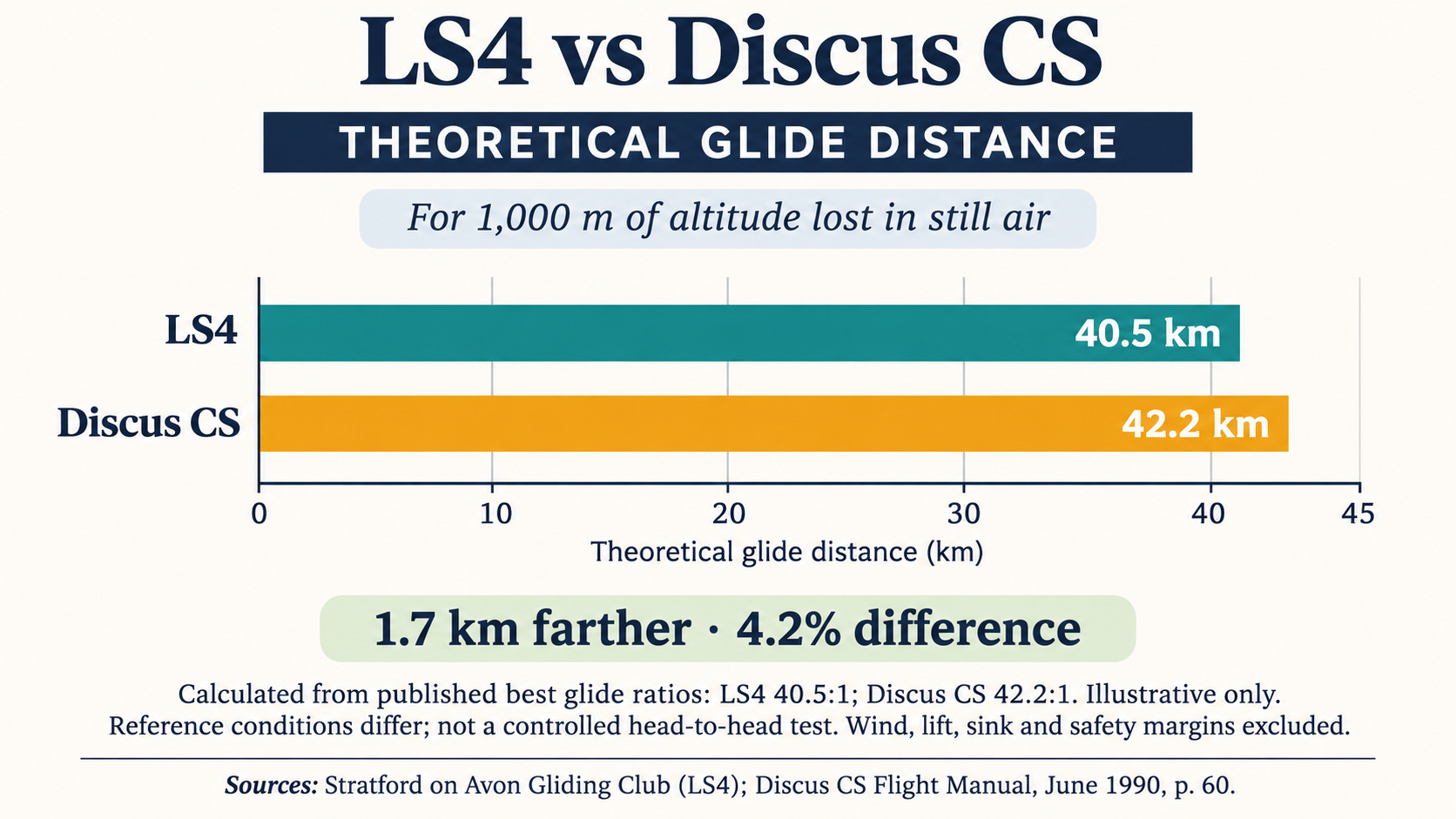
Published figures for the original LS4 generally place its maximum glide ratio at approximately 40:1 to 40.5:1. The Discus CS Flight Manual, June 1990 edition, specifies a maximum glide ratio of 42.2:1 at 100 km/h and an all-up mass of 350 kg.
These figures suggest a modest advantage for the Discus CS in maximum glide efficiency. However, the published values are not results from a controlled comparison at identical aircraft loading and flight conditions.
Theoretical Glide Distance
| Altitude Lost | LS4 at 40.5:1 | Discus CS at 42.2:1 |
|---|---|---|
| 500 m | 20.25 km | 21.10 km |
| 1,000 m | 40.50 km | 42.20 km |
| 1,500 m | 60.75 km | 63.30 km |
| 2,000 m | 81.00 km | 84.40 km |
These theoretical distances use the selected published reference glide ratios and assume still air. They do not account for wind, rising or sinking air, maneuvering losses, or safety margins.
At an altitude loss of 1,000 meters, the calculated difference is 1.7 kilometers, or approximately 4.2 percent relative to the LS4 figure. This represents a mathematical difference between published reference values, not a verified performance advantage under identical test conditions.
Although small differences in glide efficiency can matter during long cross-country flights, maximum glide ratio does not describe performance at every airspeed.
Why Best Glide Speed Matters
A glider achieves its maximum glide ratio at a particular airspeed.
In still air, flying slower than the speed for maximum glide ratio reduces the horizontal distance available for a given loss of altitude because induced drag becomes increasingly significant.
Flying significantly faster also increases drag, reducing the horizontal distance traveled for a given loss of altitude.
This means the best glide speed represents a particular balance between airspeed and sink rate.
During cross-country flying, pilots frequently operate above best glide speed to improve their overall task speed.
Consequently, comparing maximum glide ratios alone cannot establish which aircraft performs better during fast cruising.
A meaningful comparison at higher speeds requires reliable speed polar data for both aircraft under comparable conditions.
4. Minimum Sink Rate and Thermal Performance
Minimum sink rate describes the lowest vertical descent rate a glider can achieve in still air. Unlike maximum glide ratio, which concerns horizontal distance, minimum sink is particularly relevant when a pilot wants to conserve altitude.
Published LS4 specifications indicate a minimum sink rate of approximately 0.60 m/s at around 80 km/h. The Discus CS is commonly listed with a minimum sink rate of approximately 0.61 m/s at 78 km/h under specified reference conditions.
Although these figures are close, they should not be treated as a controlled comparison. Straight-flight minimum sink does not establish which aircraft will climb faster in thermals, where bank angle, wing loading, turning radius, and the distribution of rising air all influence performance.
Thermal strength, atmospheric stability, and changing weather conditions all influence how effectively a glider can gain altitude. Understanding weather for gliding is therefore just as important as knowing an aircraft’s published minimum sink rate.
Why Minimum Sink Does Not Tell the Whole Story
When a glider circles inside a thermal, it experiences a higher load factor than during straight flight.
The wings must generate additional lift to maintain the turn, increasing aerodynamic demands and changing the sink rate.
As bank angle increases, stall speed also rises.
For example, during a coordinated, level 45-degree bank, the load factor is approximately 1.41 g.
At the same aircraft weight and configuration, stall speed increases by approximately 19 percent compared with straight and level flight.
This creates an important compromise.
A tighter circle may help the pilot remain within the strongest part of a narrow thermal. However, increasing the bank angle can also increase the glider’s sink rate.
Effective thermalling requires balancing turn radius, airspeed, bank angle, and the distribution of lift within the thermal.
LS4 and Discus CS in Thermals
The LS4 has earned a favorable reputation among pilots for its predictable handling and ability to work weak or broken lift. These characteristics can be useful when a pilot needs to make frequent adjustments to bank angle and turning position within an irregular thermal.
The Discus CS is also a capable thermal soaring aircraft, with published minimum sink performance close to that of the LS4. However, its higher published maximum glide ratio does not necessarily translate into better climbing performance while circling.
The distinction becomes more important when wing loading is considered. At the same aircraft mass, the two gliders have nearly identical wing loading because their wing areas are so similar. However, the Discus CS has a higher maximum permitted wing loading, allowing it to operate at greater loading when conditions justify additional ballast.
In weak or narrow thermals, lower wing loading can help reduce the airspeed and turning radius required for efficient circling. In stronger conditions, carrying additional ballast can improve cruising performance between climbs, although it generally increases sink rate and circling speed.
Neither aircraft has a demonstrated universal advantage in thermalling. The published minimum sink figures, handling evaluations, and loading characteristics provide useful guidance, but they do not replace comparative circling performance data under equivalent conditions.
5. Cross-Country Performance
Cross-country soaring requires more than efficient gliding.
Pilots must decide when to leave a thermal, how fast to fly between climbs, where to search for lift, and how much altitude to preserve.
The speed polar is central to these decisions.
Understanding the Speed Polar
A speed polar illustrates the relationship between a glider’s airspeed and vertical sink rate.
At lower speeds, induced drag becomes increasingly significant.
At higher speeds, profile drag and other aerodynamic losses become more important.
The minimum sink point and maximum glide ratio point occur at different positions on the polar.
Two aircraft with similar maximum glide ratios may therefore perform differently at higher cruising speeds.
This is why the LS4 and Discus CS cannot be comprehensively compared using a single glide ratio figure.
Comparing Performance at Higher Speeds
The original LS4 has a maximum permitted wing loading of approximately 45.0 kg/m², while the Discus CS can reach approximately 49.6 kg/m². This means the Discus CS can operate at a higher maximum wing loading, potentially allowing faster cruising when strong thermals make additional ballast worthwhile.
However, a higher maximum wing loading does not prove that the Discus CS has a lower sink rate at every cruising speed. For example, determining which aircraft performs more efficiently at 120, 140, or 160 km/h would require speed polar data evaluated at comparable wing loadings and aircraft configurations.
Without such matched data, the published glide ratios provide a useful indication of maximum glide efficiency but cannot establish a definitive high-speed performance winner.
MacCready Speed to Fly
MacCready theory helps pilots select an appropriate cruising speed based on expected climbing conditions.
When strong thermals are available, flying faster between climbs can improve overall cross-country speed.
When lift is weak, conserving altitude becomes more important.
The ideal cruising speed depends on the expected climb rate, wind, aircraft loading, and atmospheric conditions.
Neither the LS4 nor Discus CS has one universally correct cruising speed.
Flying Into a Headwind
A headwind reduces the distance a glider can cover over the ground for a given loss of altitude.
Flying at the still-air best glide speed may not provide the best ground range when facing a headwind.
A higher airspeed may improve progress into the wind, although the increased sink rate must also be considered.
The Discus CS’s published glide advantage is relevant, but determining which glider performs better into a strong headwind requires comparison of their complete speed polars.
6. Water Ballast: How Extra Weight Changes Performance
Water ballast is an important feature of both aircraft.
Although adding weight may initially appear undesirable, increased wing loading can improve cross-country performance under suitable conditions.
When ballast is added, the glider’s performance curve shifts toward higher airspeeds.
The aircraft can achieve approximately the same maximum lift-to-drag ratio at a higher speed, although its minimum sink rate increases.
This can be advantageous when strong thermals allow the pilot to recover altitude quickly.
During weak conditions, however, the additional sink rate and higher circling speed may reduce performance.
LS4 Water Ballast
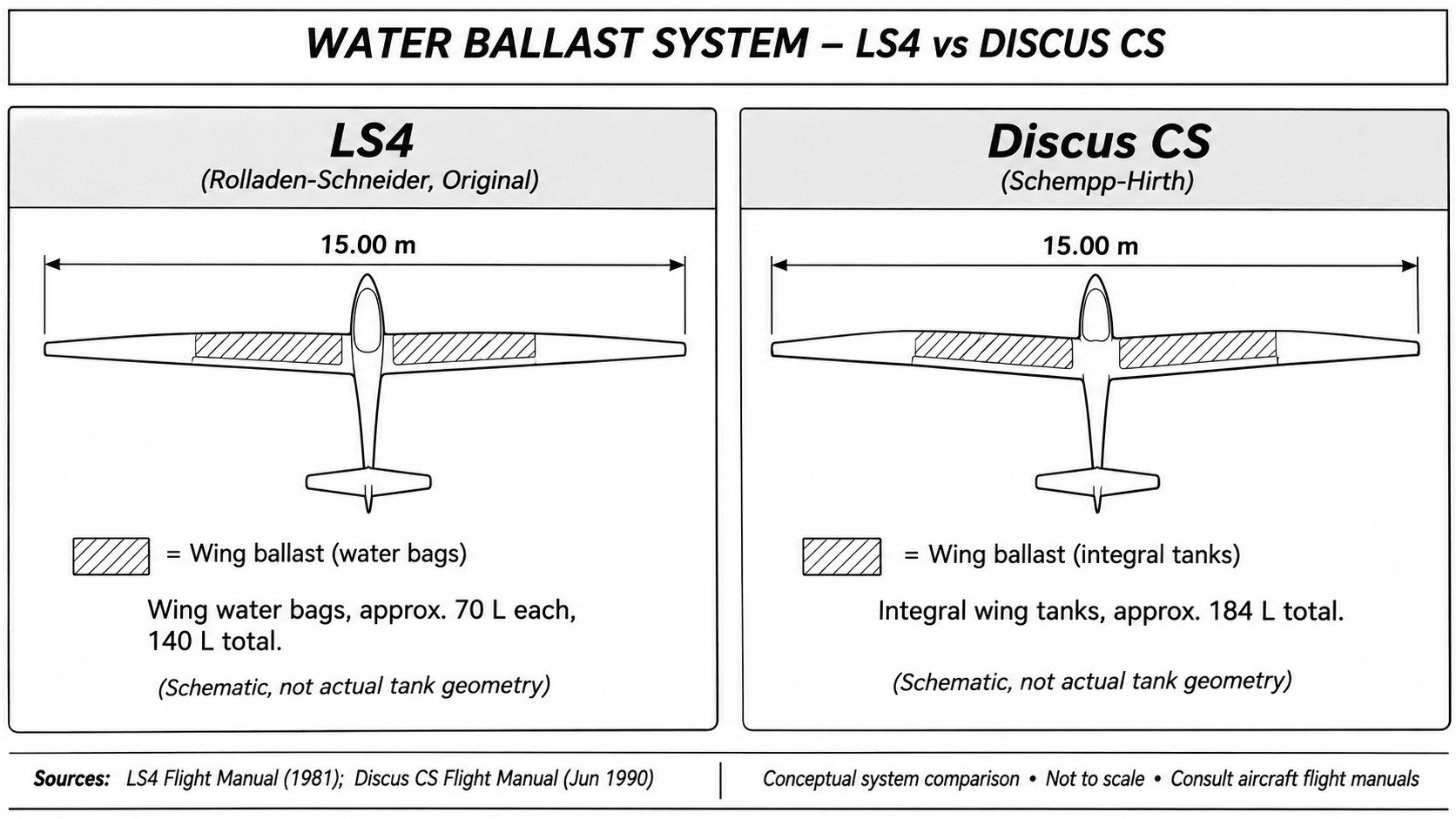
The original Rolladen-Schneider LS4 uses flexible water bags installed inside its wings, with a nominal capacity of approximately 70 liters per wing, giving a combined capacity of 140 liters. However, this does not mean that every LS4 can carry the full amount on every flight.
The permitted ballast load depends on the aircraft’s empty weight, pilot and parachute weight, installed equipment, and maximum takeoff mass. The original LS4 has a maximum permitted mass of 472 kg. For example, its flight manual provides a loading case in which an aircraft weighing 240 kg empty, with a pilot and parachute weighing 95 kg, is permitted to carry 137 kg of water ballast.
The LS4-a may also be equipped with an optional system using approximately 85-liter water bags in each wing, increasing the nominal capacity to 170 liters. This configuration should not be assumed to apply to every LS4-a, and some original LS4 aircraft may have approved modifications.
With a wing area of 10.50 m², the original LS4 has a maximum wing loading of approximately 45.0 kg/m² at its 472 kg mass limit. The amount of ballast actually carried must remain within the aircraft’s approved loading and center-of-gravity limitations.
Discus CS Water Ballast
The Schempp-Hirth Discus CS uses integral wing water tanks rather than the flexible water bags found in the original LS4. Its flight manual describes a combined wing ballast capacity of approximately 184 liters.
The Discus CS has a maximum permitted all-up mass of 525 kg. However, as with the LS4, its nominal tank capacity does not determine how much water can be carried on a particular flight. The permissible amount depends on the aircraft’s actual empty weight, pilot and parachute weight, installed equipment, and approved loading limits.
For example, if a Discus CS has an actual empty mass of 270 kg and carries a pilot, parachute, and equipment totaling 95 kg, the remaining mass allowance would be 160 kg before reaching the 525 kg maximum. This is an illustrative calculation, not a flight-manual loading example or an authorization to carry 160 liters of water. The applicable weight and balance documentation and ballast limitations must still be checked.
The Discus CS also has a documented fin ballast provision for center-of-gravity management. Its use is subject to specific operating limitations and must not be confused with the wing ballast capacity.
With a wing area of 10.58 m², the Discus CS reaches a maximum wing loading of approximately 49.6 kg/m² at 525 kg. This allows operation at a higher maximum wing loading than the original LS4, although the actual loading used in flight depends on the aircraft and conditions.
Water Ballast Comparison
| Specification | Original LS4 | Discus CS |
|---|---|---|
| Wing ballast system | Flexible water bags | Integral wing tanks |
| Nominal wing ballast capacity | Approx. 140 L | Approx. 184 L |
| Maximum permitted all-up mass | 472 kg | 525 kg |
| Wing area | 10.50 m² | 10.58 m² |
| Maximum wing loading | 45.0 kg/m² | 49.6 kg/m² |
| Permissible ballast | Aircraft loading dependent | Aircraft loading dependent |
| Fin ballast | Not part of the cited original configuration | Documented provision |
What Does This Mean for Performance?
The Discus CS has a larger nominal wing ballast capacity and a higher maximum permitted wing loading than the original LS4. This gives it a wider potential range of operating weights, which can be useful when stronger thermals support faster cross-country cruising.
However, higher wing loading also increases the speeds associated with minimum sink, best glide, and stall. Carrying additional ballast can therefore become disadvantageous when thermal conditions weaken.
The important distinction is between tank capacity, permitted ballast load, and the wing loading actually used during flight. These are related but different measurements, and all three must be considered when comparing the aircraft.
7. Handling and Flight Characteristics
Glide ratio and sink rate are important, but handling characteristics often have a greater influence on how comfortable a pilot feels in an aircraft.
Control response, stability, coordination, stall behavior, and landing characteristics all affect the flying experience.
LS4 Handling
The LS4 is widely regarded as a forgiving and predictable glider.
Its handling characteristics have contributed to its popularity among gliding clubs and pilots progressing into higher-performance aircraft.
A manageable control response can be particularly valuable during thermal soaring, aerotow, and approach.
However, pilots must still receive appropriate familiarization before flying the LS4 independently.
Discus CS Handling
The Discus CS is also an established aircraft with documented handling and operating procedures.
Its control response, stall characteristics, and approach behavior are described in the applicable flight manual.
Although the aircraft is designed for high-performance soaring, its handling should not be judged solely by its aerodynamic efficiency.
The exact feel of the controls and the aircraft’s response during different maneuvers are best evaluated through appropriate training and direct experience.
Stall Characteristics
The original LS4 flight manual provides unballasted straight-flight stall speed figures of approximately 65 to 70 km/h.
The Discus CS manual specifies approximately 69 km/h at a reference mass of 350 kg.
These figures refer to particular conditions and should not be treated as identical test configurations.
Stall speed increases with aircraft weight and load factor.
Consequently, pilots must use the appropriate operating speeds for the aircraft’s actual configuration.
Takeoff and Aerotow
Both aircraft support aerotow operations.
The LS4 has a favorable reputation for manageable towing characteristics.
The Discus CS manual also provides detailed aerotow procedures and limitations.
Takeoff handling depends on several factors, including wind, runway conditions, aircraft loading, pilot technique, and the response of the controls.
Pilots transitioning between the two aircraft should follow the appropriate familiarization procedures rather than assuming identical handling.
Landing Characteristics
Both aircraft use retractable landing gear and airbrakes.
The LS4 is known for effective airbrakes and manageable landing behavior.
The Discus CS also has effective airbrakes that allow the pilot to control the descent angle during approach.
Its flight manual specifies normal approach speeds for particular loading conditions, including 95 km/h in the stated reference configuration and 115 km/h at maximum all-up mass.
These figures are aircraft-manual references, not universal recommendations for every flight.
8. Cockpit Comfort and Pilot Experience
Cockpit comfort becomes increasingly important during long soaring flights.
A pilot may spend several hours seated in a relatively confined space, making ergonomics an important part of aircraft selection.
LS4 Cockpit
The LS4 has a cockpit arrangement that has proven practical for many club and private pilots.
Its seating position, canopy, control layout, and instrument panel contribute to the overall flying experience.
However, individual LS4 aircraft can differ considerably in cockpit equipment.
Some retain relatively traditional instrument layouts, while others have been upgraded with modern flight computers, navigation displays, and electronic variometers.
Discus CS Cockpit
The Discus CS features a semi-reclining seating position and a sideways-opening canopy.
Its cockpit was designed to accommodate the demands of extended soaring flights.
As with the LS4, instrument equipment varies between individual aircraft.
A privately owned Discus CS may have a substantially different panel from a club-operated example.
Which Cockpit Is More Comfortable?
There is no universal answer.
Comfort depends on the pilot’s height, body proportions, seating preferences, parachute, and equipment.
Before purchasing either glider, pilots should assess cockpit fit and ensure they can operate all controls comfortably.
An aircraft that fits the pilot properly may be a better long-term choice than one offering a small theoretical performance advantage.
9. Maintenance and Ownership Considerations
For pilots considering private ownership, maintenance history and aircraft condition are often more important than small differences in published performance.
Both the LS4 and Discus CS are composite aircraft.
Their condition must be assessed through appropriate inspections, maintenance records, and compliance with applicable airworthiness requirements.
Structural Condition
Composite aircraft can remain operational for many years when properly maintained.
However, age alone does not determine structural condition.
Previous damage, repairs, surface deterioration, moisture exposure, and maintenance quality all require consideration.
A well-maintained older aircraft may be a better purchase than a newer example with incomplete records.
Rigging and Control Connections
Both gliders have specific rigging procedures.
The LS4 family includes configurations using L’Hotellier control connections, which require appropriate inspection and securing procedures.
The Discus CS has its own wing assembly, control connection, and tailplane installation procedures.
Owners who regularly rig and derig their aircraft should become thoroughly familiar with the approved procedures for their particular glider.
Used Glider Buying Checklist
Before purchasing an LS4 or Discus CS, consider the following:
- Confirm the exact aircraft variant and serial number.
- Review the current flight manual and maintenance documentation.
- Verify airworthiness and inspection records.
- Examine previous damage and repair history.
- Check applicable airworthiness directives and service bulletins.
- Inspect control systems and rigging hardware.
- Examine the landing gear, wheel brake, and airbrakes.
- Inspect water ballast components and plumbing.
- Evaluate cockpit equipment and canopy condition.
- Inspect the trailer and its support fittings.
- Verify current weight and balance documentation.
- Arrange an independent inspection by a qualified glider maintenance specialist.
Which Glider Is Cheaper to Own?
There is no reliable universal answer.
Maintenance expenses depend on the individual aircraft’s condition, inspection requirements, replacement parts, storage arrangements, insurance, and equipment.
A carefully maintained LS4 may cost less to own than a Discus CS requiring major work.
The opposite may also be true.
The purchase decision should therefore be based on the complete aircraft and its documentation rather than model reputation alone.
10. LS4 vs Discus CS: Strengths and Limitations
Rolladen-Schneider LS4
Strengths
- Established reputation for forgiving handling.
- Effective thermalling characteristics.
- Proven cross-country capability.
- Long history of club and private operation.
- Suitable for pilots progressing into higher-performance soaring with appropriate training.
Limitations and considerations
- Lower published maximum glide ratio than the Discus CS in the figures compared.
- Specifications vary between LS4 versions.
- Individual aircraft condition and modifications require careful evaluation.
Schempp-Hirth Discus CS
Strengths
- Published maximum glide ratio of 42.2:1.
- Distinctive wing design developed for efficient soaring.
- Established cross-country performance.
- Documented water ballast and center-of-gravity management provisions.
- Proven Standard Class design.
Limitations and considerations
- The published glide advantage does not guarantee better performance in every condition.
- Ballast management must follow aircraft-specific limitations.
- Handling preferences and cockpit suitability vary between pilots.
- Maintenance condition and equipment differ between individual aircraft.
11. Which Glider Should You Choose?
Choosing between the LS4 and Discus CS depends on the pilot’s priorities.
A pilot transitioning into higher-performance single-seat gliders may find the LS4 particularly appealing because of its established handling reputation and long history of club use.
A pilot interested in the Discus design and its published glide performance may prefer the Discus CS.
However, experienced pilots should avoid selecting an aircraft based solely on a difference of approximately 1.7 points in maximum glide ratio.
A well-maintained LS4 with complete documentation, suitable equipment, and a good trailer may represent a better purchase than a Discus CS with unresolved maintenance issues.
The reverse could also be true.
Final Decision Table
| Pilot Priority | Recommended Consideration |
|---|---|
| Forgiving handling reputation | LS4 |
| Higher published maximum glide ratio | Discus CS |
| Weak thermal soaring | Evaluate loading, handling, and turning performance |
| Fast cross-country flying | Compare complete speed polars |
| Club operations | Both are established options |
| Long-distance comfort | Assess cockpit fit individually |
| Private ownership | Prioritize condition and maintenance records |
| Competition flying | Consider class rules, handicaps, and task requirements |
The best glider is not necessarily the aircraft with the highest published performance figure.
It is the aircraft that suits the pilot’s experience, objectives, operating environment, and practical requirements.
Frequently Asked Questions
Final Verdict: LS4 or Discus CS?
The Rolladen-Schneider LS4 and Schempp-Hirth Discus CS are two established 15-meter Standard Class gliders with closely comparable published performance figures, but meaningful differences in wing design, ballast arrangements, and maximum permitted loading.
The Discus CS has a modest advantage in published maximum glide ratio, while the LS4 has a documented reputation for predictable handling and effective thermalling. However, the available reference figures do not establish a definitive winner across all cruising speeds or thermal conditions.
The Discus CS also offers greater nominal water ballast capacity and a higher maximum permitted wing loading. These characteristics can be useful for cross-country flying in stronger conditions, although the practical benefit depends on aircraft loading and the weather.
For prospective owners, cockpit fit, equipment, maintenance history, aircraft condition, and operating costs deserve as much attention as small differences in published performance.
Both aircraft remain capable choices for cross-country soaring. The better fit depends on the pilot’s priorities and the condition and configuration of the individual glider.
Sources and Further Reading
- Rolladen-Schneider. LS4 Flight Manual. https://www.acra.be/assets/files/FM_LS4_TN4049.pdf
- Discus CS Flight Manual. June 1990. https://www.aeroklub-edvardrusjan.si/wp-content/uploads/2017/09/FM_DCS_standard.pdf
- British Gliding Association. Discus Aircraft Data Sheet. https://www.gliding.co.uk/wp-content/uploads/sites/3/2015/04/1430312123_discus.pdf
- Waikerie Gliding Club. LS4-a Pilot Information. https://www.waikerieglidingclub.com.au/wp-content/uploads/2017/04/LS4-Pilot-Information-v2.pdf
- Mid-Atlantic Soaring Association. Aircraft Fleet Information. https://www.m-asa.clubexpress.com/content.aspx?club_id=218612&module_id=402504&page_id=22
Editorial note: This article is an educational comparison, not an operating manual. Aircraft-specific limitations, approved procedures, and maintenance requirements must always be verified against the applicable current documentation.